
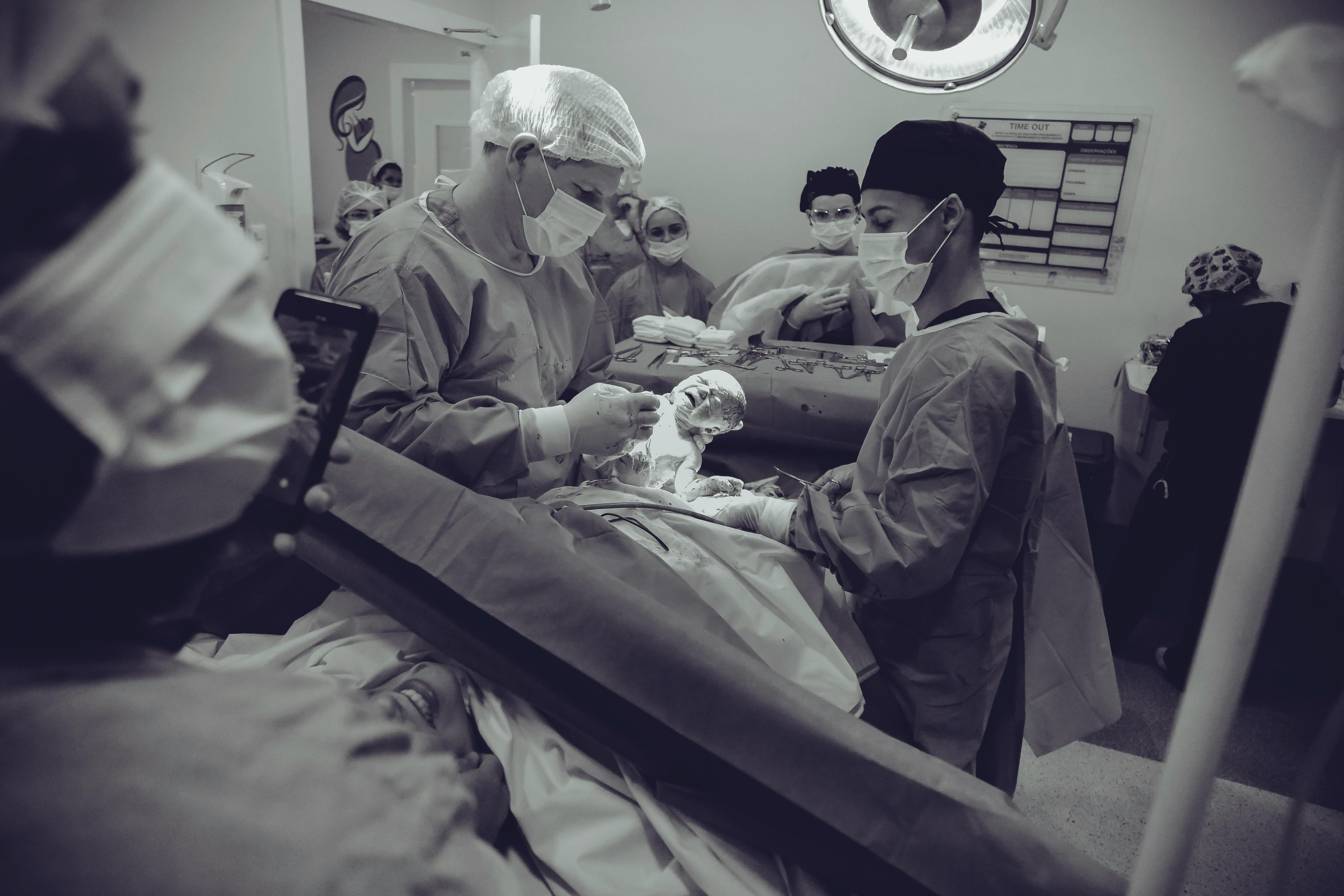
January 13 is National Cesarean Section Day, a time to recognize the millions of people who have brought life into the world through this surgical delivery and the very real emotions that can come with it.
As a reproductive psychiatrist, I sit in the tension every day: c-sections are often life-saving, and they can also be scary, unexpected, and deeply emotional. Many of my patients are left navigating not only physical recovery, but also emotional aftermath including feelings of fear, guilt, or even trauma.
So let’s talk about it.
Let’s start here: C-sections are birth.
Whether your cesarean was scheduled, chosen, or emergent, your body still grew a baby, and you still brought that baby into the world. I've heard of c-sections being called a "moon roof birth" and that made me chuckle!
C-sections can be life-saving for both mother and baby. They are a crucial option in modern obstetrics and sometimes the safest way forward. You don’t need to justify that to anyone. We can also acknowledge there are times where c-sections might be overused, coerced, or otherwise misused in medical settings, but that isn't the point of this article.
The point is: your birth story and your feelings about it are valid, no matter how it unfolded.
Here’s what I hear from patients again and again:
All of those feelings are real.
Just because a c-section was medically indicated doesn’t mean it wasn’t emotionally difficult. The sterile environment, the lack of control, the hurried decision-making, and even the physical restraints all of this can activate your nervous system and become traumatic. Even if the environment was supportive if you had imaged another scenario, say immediate skin-to-skin, and you didn't get the opportunity to do what you imagined you can still go through a grief process for the experience you didn't get. Even if the one you had was "fine."
And if you felt dismissed, unsupported, or afraid during or after your delivery? That can be a form of birth trauma. You’re not overreacting, and you’re not alone. It is well known in the medical community that a c-section is major surgery. But I'm not sure the general societal consensus understands this! A lot of time I've heard patients being told they "took the easy way out" or "should be grateful" that they didn't have the difficulties associated with a vaginal birth. Sometimes pregnant people fully dilate, partially dilate or even go through extensive time pushing before the decision is made to go for a c-section. They're not mutually exclusive! So not only are new parents left dealing with the physical impact of major surgery while caring for an infant but they're also dealing with invalidation from others about how hard it is!
Research shows that people who have unplanned or emergency cesarean deliveries may be at increased risk of PTSD and postpartum depression.
You deserve support not just for your incision, but for your whole self, especially if you're struggling with what happened.
One of the most damaging things we can do to ourselves is invalidate our pain because “others have it worse” or “at least the baby is okay.” So what you can do today is learn to hold two truths.
Yes, gratitude is powerful. But grief is allowed here too.
You can love your child and feel sad about how they were born.
You can be proud of yourself and wish things had gone differently.
Both can be true. And honoring both is part of healing.
To everyone who has had a cesarean section: I see you.
I see your courage. I see your grief. I see the strength it took to walk into (or be wheeled into) that OR, to lay down, to endure, to hold on.
You didn’t take the “easy way out.” You took the way that brought you and your baby here safely..that is the truest root of motherhood.
And that’s something worth honoring.
If you're looking for a place to start give us a call at (512) 982-4116 or request an appointment here and our team will help guide you. We are available via telehealth to anyone in Texas.

By Sarah Rivers Deal, PhD, LPC With Perinatal Loss month in October, I wanted to introduce myself through this blog as well as cast a light in the often dark places that hold this kind of silent, disenfranchised grief. As a psychotherapist that specializes and has been trained in infertility counseling, I too experienced my own reproductive trauma. Five years of fertility and alternative medicine treatments yielded a roller coaster of emotions, existential crises, and ultimately, two small graves in our back yard. Allow me to share something I wrote after my first miscarriage. We read to know that we are not alone – and – you are not alone. If you’re like me, the struggle to create life took over my life. It was all I thought out, dreamt about, planned for, spoke about, made exceptions for, ate for, stopped drinking my favorite red wine for – you name it. Life became hinged on hypotheticals – What if we get pregnant after I accept this new position? What if I accept this invitation then can’t travel in a few months because I’m pregnant? Should we buy the house in the better school district or wait until little one is here? What if little one never gets here? As much as I tried to balance my life, infertility crept in at every turn. In her insightful memoir, The Art of Waiting, Belle Boggs describes this all-consuming experience, calling it the Take Over – “…the problem with infertility is that it is not a patient, serene kind of waiting, not a simple delay in your plans; it happens for many of us in the context of consuming struggle, staggering expense, devastating loss.” Deciding to pursue fertility treatments put my barrenness on the front burner, making it difficult to escape. After five years in fertility clinics, more people had seen my vagina than the inside of my home. What was supposed to be private and magical between my partner and I was now public and scientific. All around me, women were “blessed” with babies, flaunting them as little “miracles.” These terms are especially painful for those struggling to conceive, as it implies that certain people are chosen while others are not. As much as I tried to participate in the world, being around pregnant women or infants was hazardous to my mental health. I remember attending my first baby shower in several years, believing I was safe now because my partner and I were months away from our daughter (by way of adoption) being born. Hope had begun to blossom again in my heart, as I believed that soon I would be a mom too. While I was emotionally prepared for my friend Serena to be eight months pregnant (after years of trying and two miscarriages), I wasn’t informed that the shower host was visibly pregnant too, and to boot – after only one round of I.V.F. with the same doctor I used. As we munched on our blue painted cookies shaped like pacifiers, I learned that the champagne drinking host had a 9-year-old son already, and became recently engaged after finding out about the pregnancy. I wish I could say I genuinely celebrated her happy news, but on the inside, I was fuming. On the drive home, with no other car in sight, I blasted the radio and screamed bloody murder. Despite various challenging life experiences up to this point, I still somehow believed in the concept of justice – a philosophy of how fairness is administered. To put it simply, it seemed unfair to me that this host woman was pregnant and going to be a mom – for the second time – and all I had to show were memorial stones in my yard commemorating two pregnancy losses. Unfair that I had earned high marks for effort and still wasn’t getting to graduate. Unfair that I wasn’t stroking my own belly, marveling at the miracle of science and creation itself. Infertility or perinatal loss may be experienced as an existential crisis, planting seeds of doubt in life questions you thought you had basically addressed, figured out, or had plenty of time to answer. What legacy will I leave behind? Who will carry on my values? Who will remember me after I’m gone? Am I broken? Dr. Anne Malavé, mental health expert in the field of infertility, wrote – “Infertility is like trying to find your children. The child, the imagined and expected child whose presence is palpable yet missing, feels near. It feels like searching for a lost child–you keep looking and searching around every corner. To stop trying can feel like an abandonment of an actual baby, of “my/our own baby.” Pamela Mahoney Tsigdinos in her raw, genuine book Silent Sorority, poignantly captures this existential crisis – “One instant you are like everyone else. The next, you’re not. Your DNA now ends with you. You are infertile. Your branch of the family tree will forever be just a truncated twig. You’ve been denied a rite of passage, a biological imperative. You had no say in the matter. It wasn’t a conscious choice. The comfortable sense of continuity and legacy others take for granted disappears in an instant.” After experiencing perinatal loss in 1999, Amy Douglas poetically wrote: “A life inside me, a love so strong. She died inside me, but the love lives on. It broke my heart for her to go. I love her, I need her like she’ll never know.” If infertility and/or pregnancy loss have ever been downplayed as a less significant human loss, Tsigdinos, Malavé, and Douglas legitimize the profound aftershocks of devastation experienced by those affected. From my personal and professional experience, I want you to know that the takeover is part of the journey. Well- meaning partners and friends might advise you to find a hobby to try to get your mind off of it, to relax, but that probably won’t help. It IS where you are right now, and that’s okay. Most people will be uncomfortable with your discomfort, and you’ll likely receive your fair share of unsolicited and unhelpful advice. Being the recipient of said advice, I tried to remind myself to listen to their intentions, not words. Week after week, clients that struggled with infertility would say something like – “These next few weeks I want to focus on my work and getting back into exercise” or “I want to start hanging out with my friends again and expanding my social circle.” We would set vague or concrete goals, depending on the client, and vow to focus on balance and self-care. And then, week after week, these same clients would come in ashamed, embarrassingly admitting that even if they did go to the gym or see an old friend, the ghost of infertility haunted them. They wanted to be more present in the here-and-now, they really did. Although I truly believe the takeover must run its course, there may be some coping skills and strategies to help it along. And I’m certain that whatever I tell you won’t always work. Some days the takeover will allow some wiggle room to remember the other aspects of your life; other days – it won’t. If you’ve felt quite low more days than not, and for an extended period of time, please check it out with a doctor. I will share with you the most salient professional (and personal) guidance here, and hope that on a few days, it might help. But please, don’t beat yourself up if it doesn’t. Honor the takeover, but also look for windows where you can see the larger picture. 1. Do something that has direct, observable results. You likely have felt powerless for a while. I want to you to do something, no matter how simple, where you can see results. Start with something easy. Make your bed. If you feel relatively competent cooking, use a recipe to create something, then share it with someone. Plant something that you can watch grow. Start with a plant that’s native and more likely to survive; you do not need a failure right now. Rearrange furniture in your space; a new look often evokes new feelings. 2. Practice Self-Compassion Breaks. I adopted this idea from the lovely Dr. Kristin Neff, a self-compassion researcher and professor from my town in Austin, Texas. Here’s the step-by-step process: a) When you notice that the Take Over has happened, say to yourself: “This is a moment of suffering” or “This hurts.” (It may help to place one hand over your heart = self-soothing gesture) b) Then say, “Suffering is a part of life.” c) Then, “May I give myself the compassion or understanding that I need right now.” Then breathe in and out, consciously and with intention. 3. Mindfulness (paying attention on purpose) is an Eastern practice, but its application has hit Western shores, and I’m a firm believer that it’s a necessary healing tool in your toolbox. You can become a conscious consumer of your mind, observing with a curious and gentle sense what’s going on in there. None of us would believe that a face cream could make us look a certain way after a few applications. However, we often experience our thoughts as facts, then experience powerful emotions as a result. It’s important to get some space from our thoughts, and see them for what they are – potentially unhelpful narratives. Use the letters N-N-R to remember the steps: a) Notice. Your mind is an active, interesting narrator that tries to piece information together but often falls short. Become a neutral, curious observer of your mind. Think of it as a radio, always playing music (some songs on repeat). b) Name (thoughts, feelings, body sensations, urges). For example, you may be ruminating (circular thinking that goes nowhere except down) something like “It’s not fair Tamara is pregnant. She didn’t even want another baby” and so on. As soon as you notice you’re stuck on a loop, say to yourself – “That’s a thought” You may notice tightness in your chest. Ask yourself what your feeling. Then say, “I’m having a feeling of sadness.” Noticing and naming gives you critical space to honor what’s going on with you without letting it suck you in automatically. c) Re-engage: Get back to what you were doing before you got caught in the loop. Re-engage in the moment. 4. Make a playlist or soundtrack for various themes throughout your fertility/infertility journey. For example, weeks before my 2nd I.V.F. transfer, I made a compilation of uplifting songs, burned them on a CD that I titled “Hope,” and played it every chance I got. A week after my first miscarriage, I made another playlist, calling it “Coping.” These songs were instrumental in helping me process the often contradictory emotions I experienced. Your body’s limitations don’t define you. Focus on what your body CAN do for you right now. Can you walk, jog, skip, hop, swim, or hug someone? It’s easy and completely understandable to get caught on a failure-loop narrative. But you’re not a failure. This is your roadblock, your life challenge, your grief and sorrow, your call to action. Answer the call, my friends. Above all, be patient with yourself. You are not alone. (Originally written September 2017; Revised September 2020) Dr. Sarah Rivers Deal is an Austin-based licensed professional counselor that specializes in infertility and reproductive trauma. She’s a member of the American Society for Reproductive Medicine (ASRM) and has participated in numerous trainings on infertility counseling and perinatal loss.
Read Blog Post
In the era of Google, there is a massive amount of information available about antidepressants. Even for a medical professional, it can be daunting to know what’s real and what’s not. Considering this decision can impact the lifelong health of a baby though, it’s important to be informed.
Read Blog Post